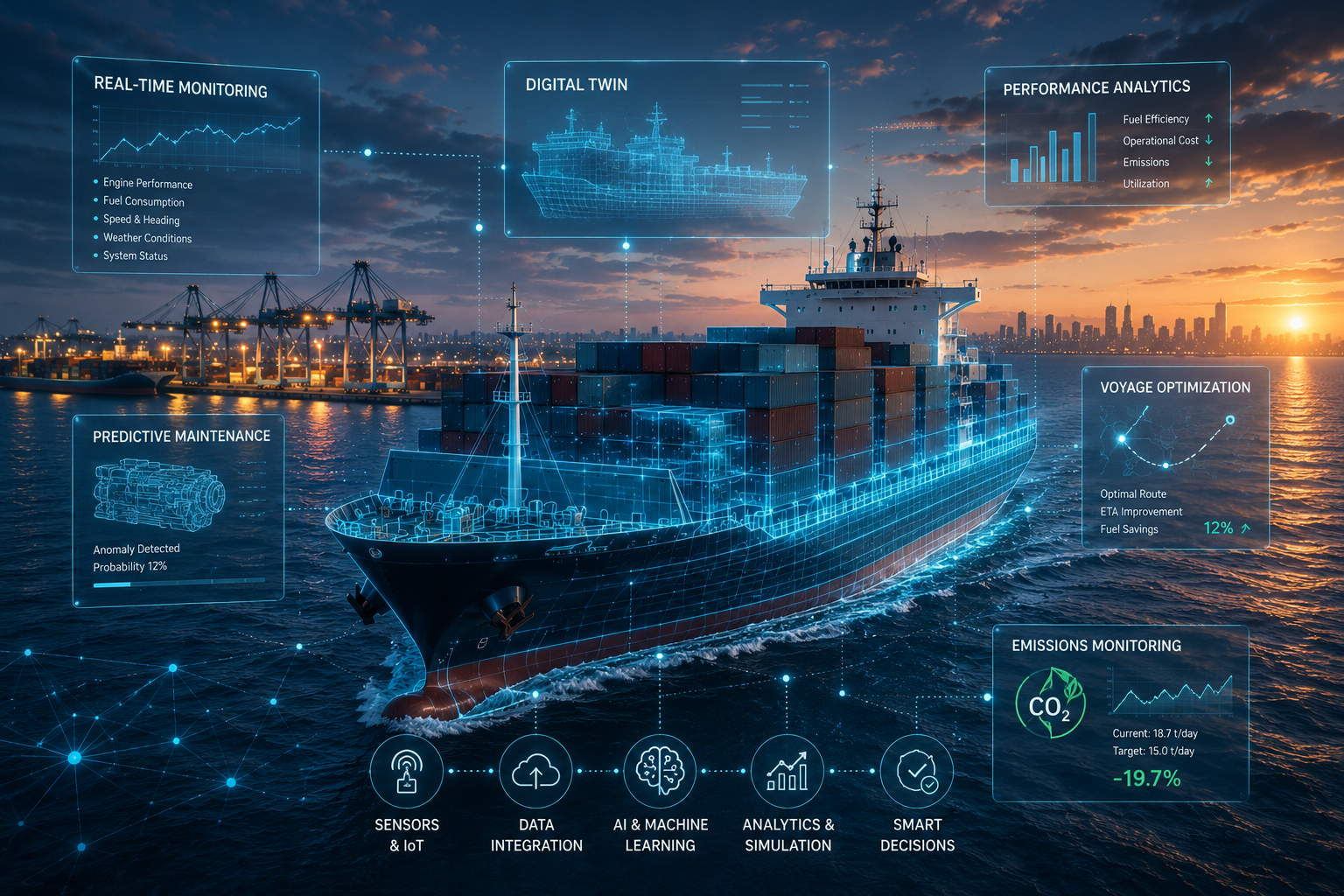
Discover how digital twin technology in shipping combines real-time vessel data, AI and simulation to improve ship performance, predictive maintenance, fuel efficiency and maritime decision-making.
The future of shipping is becoming increasingly connected, data-driven and intelligent. Shipowners and fleet managers are exploring digital technologies that help them understand vessel performance, anticipate operational problems and make better decisions throughout a ship's lifecycle.
One technology gaining attention across the maritime industry is the digital twin.
A digital twin of a ship is a digital representation of a physical vessel, system or component that can use real-world operational data to monitor performance, analyse behaviour and simulate potential scenarios.
By combining vessel data, sensors, engineering models, artificial intelligence and predictive analytics, digital twin technology can help shipping companies move beyond traditional monitoring towards more proactive vessel management.
But what is a maritime digital twin, how does it work, and what practical benefits can it deliver to shipowners?
What Is a Digital Twin in Shipping?
A digital twin in shipping is a digital model of a physical vessel, onboard system, equipment component or maritime asset that is connected to real-world information and updated according to its intended design and data architecture.
Unlike a static 3D model, a digital twin can incorporate operational data to represent how a physical asset behaves under actual conditions.
Depending on its scope, a ship digital twin may represent:
- An individual engine or machinery system.
- A ship's propulsion and energy systems.
- Hull and structural performance.
- Fuel consumption and vessel efficiency.
- A complete vessel and its operating conditions.
- Fleet-level performance across multiple ships.
The level of sophistication varies. Some systems focus on monitoring and visualisation, while more advanced digital twins combine simulation, predictive analytics and feedback mechanisms.
A digital twin is not automatically a complete virtual copy of a ship. Its usefulness depends on the quality of the underlying data, the accuracy of the model, the purpose of the application and how frequently it is updated.
How Does Maritime Digital Twin Technology Work?
A maritime digital twin combines information from a physical vessel with a digital model designed to analyse, monitor or simulate that vessel's behaviour.
The process generally involves five components.
1. Data Collection From the Physical Vessel
The vessel generates information through sensors, onboard equipment, navigation systems and operational reports.
Common data sources include:
- Engine and machinery sensors.
- Fuel consumption measurements.
- Flowmeter readings.
- Noon reports.
- GPS and AIS information.
- Voyage and speed data.
- Weather and sea conditions.
- Maintenance and equipment records.
The availability of these sources depends on the vessel, its equipment and connectivity.
2. Data Integration and Processing
Information from different sources is collected, organised and processed.
This stage may involve checking data quality, standardising units, synchronising timestamps and identifying missing information.
Reliable data integration is essential because inconsistent or incomplete inputs can reduce the accuracy of digital twin outputs.
3. Creating the Digital Model
The digital model represents the vessel, equipment or operational system being analysed.
Depending on the application, it may include engineering models, performance relationships, simulation logic, vessel specifications and operational parameters.
The model is designed around a specific use case rather than simply recreating the ship visually.
4. Analytics, Simulation and AI
The digital model can use operational information to analyse vessel behaviour, estimate performance and explore potential scenarios.
Applications may include:
- Fuel-consumption forecasting.
- Engine performance analysis.
- Maintenance planning.
- Voyage optimisation.
- Energy-efficiency assessment.
- Emissions estimation.
- Operational scenario simulation.
AI and machine learning may enhance some digital twins by identifying patterns, predicting potential outcomes and supporting more complex analyses.
5. Insights and Operational Decisions
The resulting information can help shipowners, engineers, fleet managers and operations teams understand performance and investigate issues.
A digital twin may help answer questions such as:
- Why is a vessel consuming more fuel than expected?
- How could different operating speeds affect consumption?
- Is equipment performance changing?
- What could happen under different voyage conditions?
- Which maintenance intervention should be investigated?
- How might a retrofit affect energy efficiency?
The value comes from turning vessel data into information that supports decisions.
7 Practical Applications of Digital Twins in Shipping
1. Predictive Maintenance and Equipment Monitoring
Digital twins can support predictive maintenance by comparing equipment behaviour with expected operating conditions and analysing changes over time.
For example, a digital model of a propulsion system may help identify unusual performance trends, changes in operating efficiency or conditions that warrant engineering investigation.
Instead of relying exclusively on fixed maintenance intervals or reacting after equipment failure, operators may gain additional information to plan inspections and maintenance.
Digital twin predictions should complement maintenance schedules, inspections and engineering judgement—not replace them.
2. Fuel Consumption and Vessel Performance Optimisation
Fuel efficiency is a major operational consideration for shipowners.
Digital twins can use vessel performance models and operational information to evaluate fuel consumption under different conditions.
Depending on the model and data available, operators may analyse:
- Vessel speed.
- Engine load.
- Fuel consumption.
- Trim and draft.
- Weather conditions.
- Sea state.
- Route characteristics.
- Hull and propulsion performance.
This can help teams understand performance deviations and evaluate potential efficiency improvements.
A useful digital twin should account for operating conditions rather than comparing fuel consumption without context.
3. Voyage Planning and Operational Scenario Simulation
Digital twins can support voyage planning by allowing teams to analyse different operational scenarios.
For example, a ship's performance model may help evaluate the potential impact of changes in speed, weather conditions, route or operating profile.
Scenario analysis can support planning decisions, although actual voyage conditions may differ from simulated assumptions.
4. Energy Efficiency and Decarbonisation
Digital twins can support maritime decarbonisation by helping operators understand energy consumption, evaluate efficiency measures and explore potential operational improvements.
Applications may include:
- Fuel consumption analysis.
- Energy-efficiency monitoring.
- Alternative operating scenarios.
- Retrofit assessment.
- Emissions performance modelling.
- Carbon-intensity forecasting.
For example, a digital model could help assess how a proposed operational change or efficiency retrofit might affect vessel performance.
The results depend on model accuracy and assumptions. Simulations are useful for planning, but they do not replace verified emissions calculations or applicable regulatory methodologies.
5. Predictive Emissions and CII Performance
Operational data used for vessel performance analysis may also support emissions and carbon-intensity monitoring.
Digital twin models can help teams understand how fuel consumption, distance travelled and operating patterns influence potential emissions and performance outcomes.
When integrated with reliable operational records, analytics may help identify trends that require attention before the end of a reporting period.
For shipping companies managing EU MRV, IMO DCS, CII, EU ETS and FuelEU Maritime workflows, connecting operational insights with compliance data can provide additional visibility.
6. Ship Design, Engineering and Retrofit Planning
Digital twins can support ship design, engineering analysis and lifecycle planning.
Engineers may use models to explore changes to equipment, propulsion systems, vessel configurations or energy-efficiency technologies.
Potential applications include:
- Evaluating equipment performance.
- Simulating operating conditions.
- Assessing retrofit options.
- Exploring energy-efficiency improvements.
- Supporting maintenance and lifecycle planning.
The model can help compare alternatives before implementing changes on a physical vessel.
7. Fleet-Level Performance Management
Digital twin technology can also support fleet management when models and operational data are connected across multiple vessels.
Fleet teams may compare vessel performance, identify unusual trends, analyse operating conditions and prioritise investigation.
This can improve visibility across the fleet, although meaningful comparisons require consistent data, suitable baselines and consideration of differences between vessel types, routes and operating conditions.
Digital Twin vs IoT vs AI vs Predictive Analytics
These technologies are connected, but they perform different functions.
| Technology | Main purpose | Maritime example |
|---|---|---|
| IoT | Collect data from physical devices and sensors | Measuring engine temperature or fuel flow |
| AI | Analyse information, identify patterns and support decisions | Detecting unusual vessel performance |
| Predictive analytics | Estimate future outcomes using data and models | Forecasting fuel consumption |
| Digital twin | Represent and analyse a physical vessel or system using connected data and models | Simulating vessel performance under different operating conditions |
| Automation | Execute or assist repeatable processes | Automated alerts or reporting workflows |
A digital twin may use IoT data, AI, predictive analytics and simulation together.
However, a system that displays vessel data is not necessarily a digital twin, and an AI prediction does not automatically constitute a digital twin.
Understanding these distinctions helps shipowners evaluate maritime technology solutions more accurately.
Digital Twin vs Digital Model vs Digital Shadow
The terminology matters when evaluating technology vendors.
Digital model: A digital representation of a physical object or system. It may be updated manually and may not be connected to real-time operational information.
Digital shadow: A digital representation that receives data from the physical asset, with information flowing primarily from the physical system to the digital representation.
Digital twin: Depending on the definition and implementation, a digital twin may maintain a more continuous connection between the physical asset and its digital representation, potentially supporting simulation and bidirectional interaction.
Not every maritime vendor uses these terms consistently. Shipowners should evaluate what data is connected, how frequently models are updated, what the system can simulate and whether outputs can influence operational decisions.
What Data Does a Ship Digital Twin Need?
The required data depends on the digital twin's purpose.
A vessel performance twin may need:
- Fuel consumption.
- Engine operating parameters.
- Vessel speed.
- Distance travelled.
- Draft and trim.
- Weather and sea conditions.
- Propulsion and machinery data.
A maintenance-focused twin may require:
- Equipment operating history.
- Sensor readings.
- Maintenance records.
- Failure and inspection history.
- Manufacturer specifications.
An emissions or compliance-focused application may need:
- Fuel type and quantity.
- Voyage information.
- Distance travelled.
- Relevant emissions factors.
- Reporting-period data.
- Supporting documentation.
The quality, consistency and availability of information directly affect the usefulness of the model.
Challenges of Implementing Digital Twins in Shipping
Digital twin technology can deliver value, but implementation involves several practical challenges.
Data quality and availability
Missing, inconsistent or unreliable vessel information can limit the accuracy of model outputs.
Integration with legacy systems
Ships may operate different onboard systems, equipment and software platforms. Integrating these into a unified model can require significant effort.
Connectivity limitations
Ships operate across different regions and connectivity conditions. Systems must account for delayed, intermittent or incomplete data transmission.
Model accuracy and validation
Models must be validated against actual operating conditions. A model that performs well in one vessel or environment may not generalise to another.
Cybersecurity and data governance
Connected systems introduce security considerations involving data access, system integrity, communications and operational technology.
Implementation costs and expertise
Developing and maintaining a digital twin requires suitable data infrastructure, modelling expertise, integration capabilities and ongoing maintenance.
Shipowners should begin with a specific operational problem rather than building an expensive digital twin without a clearly defined business objective.
How to Start a Digital Twin Project for a Vessel
A practical implementation approach begins with a clearly defined use case.
Step 1: Identify the problem
Decide whether the objective is fuel efficiency, predictive maintenance, emissions monitoring, vessel performance or another operational challenge.
Step 2: Establish a data baseline
Identify the available sources, data quality, reporting frequency, connectivity and missing information.
Step 3: Select a focused use case
Start with a single vessel, system or measurable operational problem.
Step 4: Build and validate the model
Develop a model appropriate to the use case and compare its outputs against real-world operating information.
Step 5: Evaluate measurable outcomes
Measure whether the system improves visibility, supports better decisions, reduces manual effort or helps identify operational issues.
Step 6: Expand based on evidence
Scale to additional vessels or applications only after demonstrating value and understanding the integration requirements.
A focused pilot can be more useful than attempting to build a fleet-wide digital twin before establishing data quality and operational value.
The Future of Digital Twins in Maritime
Digital twins are likely to become increasingly connected with AI, vessel connectivity, predictive analytics, energy management and maritime automation.
Future applications may involve more integrated models of vessels, machinery, ports and supply chains, enabling richer operational simulations and decision support.
However, progress will depend on reliable data, interoperable systems, validated models, secure infrastructure and practical use cases.
The most valuable digital twins will not simply create impressive virtual representations of vessels. They will help maritime professionals answer real operational questions and make better-informed decisions.
How Sternbow Connects With the Digital Maritime Future
The transition towards smarter shipping requires reliable operational information, connected workflows and better visibility across vessels and fleets.
Sternbow focuses on maritime compliance workflows that help teams organise vessel data, validate records, reconcile discrepancies, track exceptions and prepare regulatory reporting information.
These capabilities form part of the wider digitalisation journey—where operational data becomes more structured, traceable and useful for decision-making.
As maritime companies adopt increasingly sophisticated analytics and digital twin technologies, data quality and workflow integration remain essential foundations.
Conclusion
Digital twin technology is creating new opportunities for shipping companies to understand vessel performance, simulate operating scenarios, support predictive maintenance, improve fuel efficiency and make more informed operational decisions.
By connecting physical vessels with digital models, operational data and analytical tools, digital twins can help move maritime operations towards a more proactive and data-driven approach.
The successful adoption of digital twins will depend on more than technology. It requires reliable data, validated models, practical use cases, integration with existing systems and a clear understanding of operational value.
For shipowners and fleet managers, the best starting point is simple: identify a real problem, build a reliable data foundation and use digital intelligence to improve the decisions that matter.
The future of smart shipping will be built not just on digital representations of vessels, but on the insights and decisions those digital systems enable.
Sources
- ABS — Technology Trends 2026: Digital Twins
- Digital Twin in the Maritime Domain: A Review and Emerging Trends
- Applications of Ship Digital Twins in Maritime Transport: A Systematic Review
- Digital Twin Technologies in Sustainable Maritime Systems
This article is for informational purposes. Digital twin outputs depend on data quality, model assumptions and validation, and should not replace required inspections, verified calculations or professional engineering judgement.
Frequently Asked Questions
Key regulatory and operational answers related to this analysis.